
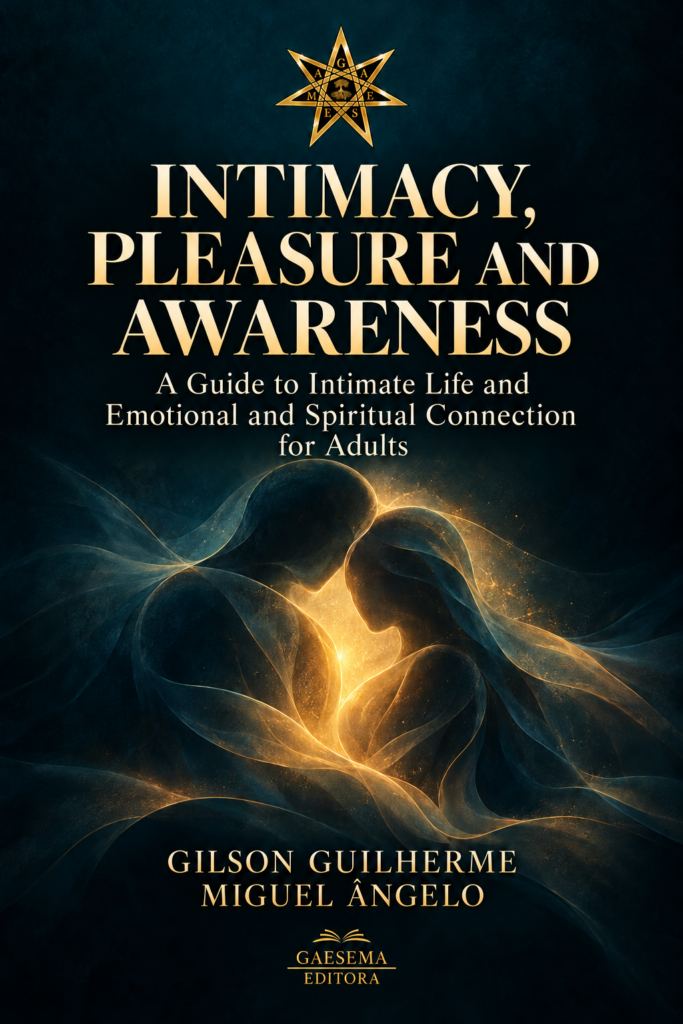
A Guide to Intimate Life and Emotional and Spiritual Connection for Adults
PUBLICATION DETAILS
PUBLISHER
GAESEMA EDITORA
MAR / ANGOLA — NAMIBIA — 2026
SERIES TITLE
THE SYSTEM
SEASON I
GAESEMA PHILOSOPHY
BOOK TITLE
INTIMACY, PLEASURE AND AWARENESS
SUBTITLE
A Guide to Intimate Life and Emotional and Spiritual Connection for Adults
AUTHOR
GILSON GUILHERME MIGUEL ÂNGELO
Angolan Thinker and Philosopher
PUBLISHED BY
GAESEMA NAMIBIA / GAESEMA ANGOLA
GRAPHIC PRODUCTION
GAESEMA NAMIBIA / GAESEMA ANGOLA
CINEMATOGRAPHIC PRODUCTION
GAESEMA NAMIBIA / GAESEMA ANGOLA
Copyright © 2026 GAESEMA
All rights reserved.
DEDICATION
I dedicate this work, first and foremost, to my beloved wife, Alexandra Marina Carvalheda Lima Ribeiro Ângelo, and to my children, for their moral support throughout the writing and organisation of this book.
To my wife, I dedicate these pages as an expression of love and appreciation for her companionship in family life and in the development of my thought. To my children, I leave a message of respect for human dignity and for the responsibility with which we should care for ourselves and our relationships.
I also dedicate this work to the memory of my dear and beloved mother, Antónia Namulena Guilherme Caiuma, whose theological guidance and Christian upbringing profoundly shaped my development.
Although she is no longer physically among us, I cherish her teachings and the memory of her counsel. Her legacy lives on in my reflections on faith, care, and the spiritual meaning of life—themes that run throughout this work.
ACKNOWLEDGEMENTS
To my wife, Alexandra Marina Carvalheda Lima Ribeiro Ângelo, I express my profound gratitude for her moral support throughout the creation of this book.
I am grateful for her companionship and for the space for dialogue that we share. In writing about intimacy, respect, and awareness, I recognise the value of a relationship in which two people continue to learn from one another.
To my children, I am grateful for their family support and for the inspiration they bring to my journey as a man, thinker, and author.
To the memory of my mother, Antónia Namulena Guilherme Caiuma, I offer my deepest gratitude for the love, upbringing, and teachings she gave me, which continue to accompany my life and my thought.
To all readers, thank you for your willingness to reflect on these pages. May this work encourage more honest conversations and relationships lived with freedom, care, and responsibility.
Gilson Guilherme Miguel Ângelo
Segue a tradução das três partes do livro, incluindo a apresentação e a conclusão. A ficha editorial, a dedicatória e os agradecimentos ficam para a etapa seguinte, conforme pediu.
PART 1
UNDERSTANDING DESIRE AND BUILDING TRUST
Introduction
A mindful intimate life begins when two people can be close without giving up the freedom to say what they feel. This book brings together philosophical reflection and communication exercises to nurture that closeness.
The intimacy explored here encompasses the body, affection, the practical circumstances of an encounter, and the spiritual meaning each person chooses to give the experience. The aim is to make pleasure more understandable and relationships more caring, without turning the body into an obligation or spirituality into a requirement.
This short book draws on SEX — Sexual Management and Administration and Gilson Guilherme Miguel Ângelo’s writings on sexual ignorance, taboo, the awakening of awareness, and the integration of body and soul. This new version brings those ideas together in an accessible approach: knowing yourself, speaking honestly, and building intimacy freely.
The author’s thought provides the philosophical foundation of the work. In his view, sex can represent several doorways: to self-awareness, to connection with another person, and to an experience of meaning. In this book, the expressions “doorway”, “vital force”, and “immaterial dimension” belong to philosophical and spiritual language. They do not refer to proven physical mechanisms or outcomes that everyone should experience.
The practical premise of this guide is that pleasure has better conditions in which to develop when there is respect, attentiveness, and communication. This does not mean that every difficulty disappears through willpower, or that everyone needs sexual activity to live well. Single people, asexual people, and those who choose abstinence retain their full dignity and their capacity to love and create.
This book is intended for adults. Its language is educational and non-graphic. The exercises are invitations, not compulsory tasks. They may be done individually or by two adults who freely agree to them. They are not intended to measure performance. If an exercise causes discomfort, adapt it or leave it aside.
How to Begin
Choose a simple question:
What would I like to understand better about my intimate life?
Write your answer without trying to impress anyone. Perhaps you want to understand desire, rebuild trust, communicate better with your partner, or find a connection between intimacy and spirituality.
The proposed path involves self-knowledge, consent, dialogue, practical circumstances, presence, reciprocity, and spiritual integration. Change will be assessed through freedom and the quality of care, rather than through the frequency of encounters or the intensity of sensations.
Chapter 1 — Understanding Desire Without Becoming Its Prisoner
Desire can draw us towards someone, awaken curiosity, and bring colour to life. It can also become entangled with loneliness, a need for approval, or fear of losing a relationship.
Understanding desire means recognising what you are seeking before deciding what to do. Feeling an urge does not oblige you to act on it, and choosing not to act does not mean rejecting your body.
The idea of dependency presented by Gilson Guilherme Miguel Ângelo can be understood as the experience of feeling that an impulse has taken up too much space. It is important to distinguish that experience from a universal claim: sexuality is not inherently a dependency. Frequent desire is not, in itself, an illness.
The decisive question is whether there is freedom of choice, respect for others, and room for the rest of life.
What We Seek When We Seek Intimacy
There are times when a person seeks intimacy but actually needs rest, conversation, or emotional support. At other times, desire is clear and can be acknowledged without shame.
Learning to recognise that difference helps prevent a partner from becoming an automatic answer to every emotional need.
We can ask:
- Do I want closeness with this person?
- Do I need affection, or reassurance that I am loved?
- Am I willing to listen to what they want?
- Can I accept that this may not be the right moment?
- Does this choice reflect my values and our agreements?
These questions are not intended to take spontaneity away from an encounter. They help us recognise what is happening within us.
The Meaning of Conscious Self-Control
Conscious self-control begins with a pause. It is not a struggle against desire; it is the opportunity to ask whether a choice makes sense at that moment.
Within the philosophical perspective developed in this book, managing vital force means recognising your own state and choosing how to act. Maturity includes the ability to desire, wait, negotiate, or decline without humiliating anyone.
A person may feel desire and decide to rest. They may want closeness and discover that their partner needs space. They may acknowledge an urge without allowing it to determine every decision.
That freedom is a form of self-knowledge.
An Exercise in Recognition
For three days, record one moment when you felt a wish for closeness.
Write down:
- What was happening before that wish arose.
- What you were feeling at the time.
- What you needed.
- The choice you made.
- How you felt afterwards.
Use concrete words: affection, rest, curiosity, safety, companionship.
The record is private. You do not need to show it to your partner.
Before acting, ask:
Do I want this experience, or do I want to stop feeling something else?
There is no perfect answer. There is information that can help you choose more thoughtfully.
When to Seek Support
If you experience a persistent loss of control, harm to your work or relationships, or distress that you cannot manage, seek help from a qualified professional.
An individual assessment is more useful than labelling every desire an addiction or attributing every problem to guilt.
This chapter invites you to acknowledge desire and recover the ability to choose. Desire can be part of life without taking the place of the whole of life.
Chapter 2
Making Peace with Your Body and Your Personal History
The body accompanies us through our personal history. It may carry memories of affection, humiliating comments, illness, changes associated with age, or expectations that are difficult to meet.
Many people approach intimacy worried about their appearance or about what they believe they must demonstrate. Those concerns deserve to be heard, not ridiculed.
The source texts challenge the shame and silence surrounding sexuality. In this guide, that appeal becomes a practical proposal: replacing self-directed insults with fairer descriptions.
A body can be tired, changed, or a source of insecurity without being unworthy of care. No one needs to conform to an ideal image to deserve respect.
Your Body Does Not Have to Be a Test
When someone feels they must prove their beauty, youth, or ability, intimacy can become an assessment.
They begin to observe themselves from the outside, wondering how they look, whether they are meeting expectations, and whether they will be compared with someone else. That concern can occupy the attention they would like to give to the encounter.
Acknowledging this does not require immediately liking every feature of your body. It can begin with a simpler attitude: no longer treating it as an enemy.
You can say:
This is my body at this moment. I can care for it while I learn to understand it.
That statement allows you to recognise changes without turning every change into a judgement against yourself.
The History Each Person Brings
Freedom also includes keeping religious beliefs, choosing privacy, and setting boundaries.
Overcoming fear does not require abandoning faith. Each person can reconsider what causes them distress and preserve what gives them meaning.
Religion and spirituality are not the same experience for everyone. Some people find comfort and guidance in them; others need to work through feelings of guilt associated with what they were taught.
What matters is being able to examine your own history without being forced to accept a single interpretation.
You also do not have to tell your partner everything. Difficult experiences do not need to be disclosed in detail for a boundary to be respected.
An Exercise in Inner Language
Write down a harsh statement you often make about yourself.
Then turn it into a description and an expression of need.
For example:
Harsh statement:
“My body is a problem.”
Description and need:
“I feel insecure about these changes, and I need time to adjust.”
The second statement does not require artificial enthusiasm. It offers a way forward.
Another example:
Harsh statement:
“I am incapable of having a happy relationship.”
Description and need:
“I struggle with trust, and I would like to learn how to communicate that.”
Changing your language does not solve everything. It helps you identify a difficulty without reducing your whole person to that difficulty.
Care That Begins Outside Intimacy
Choose an everyday form of care that you enjoy, such as walking, resting, or wearing something comfortable.
The aim is to recognise that you inhabit your body throughout the day, not only when someone is looking at it.
Ask:
How do I treat my body when no one is watching?
This question may reveal habits of self-disparagement, excessive demands, or insufficient rest. It may also make room for small, achievable changes.
A Possible Conversation
A person might say to their partner:
“There is a part of my history that makes me feel insecure. I do not need you to solve everything, but I would like you to avoid comparisons and ask how I am feeling.”
The person receiving that trust might reply:
“Thank you for telling me. What would help you feel freer?”
No one should have to disclose an intimate history as a condition of receiving affection. Care can begin by respecting a present need, even when its origins remain private.
Making peace with your body is a process. It does not have to happen all at once for you to deserve closeness, consideration, and love.
Chapter 3
Consent as the Foundation of Trust
Closeness becomes more humane when both people can choose.
To consent is to freely agree to a specific proposal while understanding what is being decided. A previous yes does not remove the need for a present choice.
A long-standing relationship, a marriage, or a gesture of affection does not establish permanent permission.
Silence, hesitation, and remaining still should not be interpreted as permission. If the response is unclear, stop and ask.
A person can change their mind without having to defend that decision. Someone who is asleep or unable to understand and choose cannot take part in that decision.
The Freedom to Want Different Things
Reciprocity does not require both people to want everything in the same way.
Two people can care for one another and have different preferences. Care is shown in how those differences are handled.
Persisting after a refusal, threatening to withdraw, or invoking a spiritual obligation turns an invitation into pressure.
It is also inappropriate to claim that someone must accept an experience to prove love, overcome a block, or demonstrate trust.
A partner’s freedom remains valid even when their response causes frustration.
Consent and Spiritual Connection
From the perspective of this book, the spiritual dimension of intimacy includes recognising the dignity of the person who is with us.
It is not enough to call an encounter sacred. The person must be treated with respect.
An experience may hold deep meaning for one partner without awakening the same feeling in the other. That difference does not indicate spiritual inferiority.
An encounter can only be shared when both people retain room to say what they feel.
Spirituality finds expression in the way another person’s freedom is welcomed.
An Exercise in Simple Agreements
At a calm moment, discuss three categories:
- What feels comfortable today.
- What needs further discussion.
- What you do not want.
Each person decides what they wish to share.
Agreements can change. The aim is to make communication easier, not to create a contract over someone’s body.
Agree on ordinary words for communicating boundaries:
- Yes: I agree to this proposal.
- Slower: I need an adjustment.
- Pause: We need to stop and check how comfortable we feel.
- No: I do not want to continue, or I do not agree to this proposal.
The word “pause” means stopping, checking comfort, and resuming only if both people want to. It should not trigger an argument or a demand.
An Everyday Example
One person suggests closeness, and the other says they are tired.
A caring response is to accept this and ask, without insisting, whether they would like some other form of companionship.
There may be conversation, a consensual embrace, or simply space.
Affection does not have to disappear because a proposal was declined.
The person whose proposal was declined may feel sad. That feeling can be acknowledged without becoming a punishment for their partner.
What Makes a Yes More Secure
The freedom to say no makes a yes easier to understand and trust.
When a partner feels able to choose, the relationship no longer has to depend on guesswork, fear, or emotional indebtedness.
That trust grows when words are matched by actions: a pause is respected, a refusal is not punished, and a preference is not ridiculed.
This is the foundation of the mindful encounter advocated in this book. Before seeking intensity, there must be enough freedom for both people to be fully present.
PART 2
COMMUNICATION AND PRESENCE IN THE ENCOUNTER
Chapter 4
Talking About Pleasure Without Turning the Conversation into a Demand
Intimate communication does not require perfect words. It requires a willingness to listen without turning the other person’s experience into an accusation.
“I miss feeling close to you” opens a different conversation from “You never give me what I need.” The first statement expresses a need; the second may put a partner on the defensive.
When we speak about intimacy, we also speak about the possibility of being known. This can bring up shame, fear of rejection, or difficulty finding words. For that reason, the conversation needs time and an attitude that allows honesty.
Understanding Rather Than Guessing
Pleasure is personal. It cannot be inferred solely from appearance, bodily responses, or what worked before.
Asking is a way of understanding. It is also important to allow incomplete answers: sometimes a person does not yet know what they want, but knows that they do not want haste or comparison.
A useful question might be:
What helps you feel close to me?
Another might be:
Is there anything we do out of habit that you would like to talk about?
These questions leave room for the partner’s own answer. They do not decide in advance what that person should feel.
Knowing someone means accepting that their experience may surprise us. A long-standing relationship also needs that curiosity: what felt comfortable at another stage may now need to be adjusted.
Choosing the Moment to Talk
A useful conversation takes place away from a moment of tension.
Choose a time with privacy and enough space to talk. Begin with what you value in the relationship, describe a specific difficulty, and suggest a small change.
Avoid turning the conversation into an inventory of every past mistake. If there are several problems, choose one to begin with.
For example:
“I like it when we have time to talk. Lately, I have felt that we are always rushing. I would like us to set aside a quiet moment this week.”
This statement expresses something appreciated, a difficulty, and a possible proposal.
The partner may agree, suggest another time, or explain a different need. The conversation becomes useful when there is room for those responses.
Expressing a Preference Without Causing Hurt
Talking about what you want does not require diminishing what you have already shared.
A preference can be expressed like this:
“I have noticed that I feel closer when we begin by talking.”
A difficulty can be expressed like this:
“When I feel that I have to meet an expectation, I become worried and find it difficult to be present.”
The aim is to share information about your own experience. The statement should help your partner understand, rather than make them feel they are being assessed.
You can also say:
“I cannot explain it clearly yet, but I would like us to have more time to understand this.”
Not knowing immediately is also a legitimate response.
A Two-Stage Listening Exercise
Each person has a few minutes to complete these statements:
- “I feel close to you when…”
- “I struggle when…”
- “One small change I would like to try is…”
The other person listens and summarises what they understood before replying.
They might say:
“If I understood correctly, you miss having time together and would like me to ask more often how you are feeling.”
The speaker confirms or corrects:
“Yes, that is it.”
Or:
“Partly. What worries me most is feeling that I cannot change my mind.”
There does not have to be immediate agreement about everything. First, it is necessary to understand what was said.
Then choose a single experience for the week: a conversation without mobile phones, a walk, or a moment of affection that both of you want.
Also agree on what to do if either person changes their mind. A simple experience freely chosen is worth more than an ambitious plan carried out through obligation.
When Honesty Reveals Pressure
If your partner says:
“I feel that I have to put on an act so that I do not disappoint you,”
first respond in a way that protects their freedom:
“I want you to be able to be honest with me.”
Then ask what creates that pressure. Listen without demanding an immediate demonstration of trust.
It can be difficult to hear that someone has not experienced the relationship as we imagined. Yet that information allows us to work with their actual experience.
Honesty should not be punished with sarcasm, punitive silence, or accusations. If the conversation becomes too intense, take a break and agree on when to return to it.
Protecting What Has Been Entrusted to You
Intimate preferences and personal accounts should remain private.
Photographs, recordings, and sharing with third parties require specific agreement. Trust includes what we do with information after receiving it.
Do not turn a confidence into a weapon during an argument. A vulnerability that has been shared deserves care even when there is conflict.
Talking about pleasure means learning a shared language through which both people can recognise themselves. That language grows when honesty is met with listening.
Chapter 5
The Material Dimension of the Encounter
Intimacy does not take place outside life.
Space, lack of rest, family responsibilities, and financial worries all enter a relationship. An interrupted conversation or an environment without privacy can make it difficult to be present.
Recognising these circumstances helps avoid attributing everything to a lack of love or a spiritual block.
A person can love their partner and be exhausted. They can want closeness and feel uncomfortable in a particular place. They can want to talk while their attention is occupied by an urgent concern.
Understanding the material realities of life is a way of knowing the whole person.
Creating Realistic Conditions
Caring for the material dimension means creating conditions that are achievable. Luxury is not necessary.
A comfortable place, unhurried time, and respect for privacy may be enough. Both people should be able to decide whether it is an appropriate moment.
No one has to accept a proposal simply because preparation or expense was involved.
A dinner, a trip, or a gift does not create an obligation to be intimate. The value of a caring gesture lies in the gesture itself.
Preparing the surroundings can express attentiveness. The willingness to participate still belongs to each person.
Care Begins in Everyday Life
Care also exists outside the encounter.
The distribution of tasks, respect for rest, and the way conflicts are resolved all help us understand a relationship. These are responsibilities of shared life that have value in themselves.
If one person constantly carries the burden of the home, the children, or family organisation, they may reach the end of the day with little capacity left. In that case, asking about desire without acknowledging tiredness leaves an important part of the experience unexplored.
A conversation might begin like this:
“I have noticed that you are very tired. How can we organise our responsibilities better?”
The purpose is to improve your shared life. Help should not be presented as something given in exchange for intimacy.
Time That Can Be Freely Chosen
Setting aside time together can be useful, especially when routine occupies almost everything.
That time does not need to have a predetermined outcome. It can be used to talk, rest near each other, or do something enjoyable.
You might agree:
“I would like us to have a quiet half-hour tomorrow. We can decide then what we feel like doing.”
In this way, the time set aside offers an opportunity. It does not establish an obligation.
If either person becomes unavailable, adapt. Flexibility allows the plan to continue serving the people involved.
An Exercise in Realistic Preparation
Each person identifies:
- One condition that makes closeness easier.
- One condition that makes it more difficult.
- One small adjustment they would like to try.
The answers can be simple:
“It helps me to know that we will not be interrupted.”
“I struggle when we are both very tired.”
“I would like us to talk before creating any expectations.”
Choose something you can adjust without much effort: reducing interruptions, choosing another time, or setting aside a conversation.
The plan should be able to be cancelled without punishment.
Health and Protection Also Belong to Intimacy
Ask a practical question:
Is there any concern about health or protection that we need to discuss?
Conversations about prevention, sexual health, and access to care belong to intimacy. They should not be left until a moment when someone feels pressured to make a quick decision.
When a question requires clinical information, consult a qualified source. Emotional trust does not remove the need to care for health.
These conversations can take place naturally. They are part of shared responsibility.
Adapting the Encounter to Reality
The surroundings may support an experience, but they cannot create willingness by decree.
If there is tiredness or unavailability, acknowledging it is part of preparation.
Maturity in dealing with material circumstances means adapting the encounter to the reality of the people involved. A relationship becomes more caring when it can accommodate what is present that day, including the need for rest.
Chapter 6
Emotional Presence and the Meaning of Pleasure Within Pleasure
One of the ideas proposed by Gilson Guilherme Miguel Ângelo is the cultivation of pleasure within pleasure.
In this guide, the expression describes the possibility of recognising different layers of an experience: the satisfaction of being close, the relief of being able to be honest, and the meaning of feeling accepted.
It is not a technique that guarantees extraordinary sensations. It is a philosophical way of understanding how an enjoyable experience can gain depth through attentiveness and connection.
A person may appreciate a gesture of affection while also feeling satisfaction in knowing that they do not have to put on an act. They may enjoy companionship and discover in it a tranquillity they had not previously been able to recognise.
These dimensions can coexist without being identical for both people.
Moving Away from Constant Self-Assessment
Pleasure can gain meaning when a person stops assessing it as a test.
The question “Am I meeting expectations?” can occupy so much attention that it becomes difficult to recognise what one feels.
An alternative is to acknowledge your present state and communicate it, without demanding that it be intense or the same as your partner’s.
You can say:
“I feel comfortable.”
“I am distracted.”
“I need time.”
“I like being here with you.”
These words help you stay in touch with your actual experience.
Presence does not require eliminating every thought. It requires being able to recognise what is happening and respond freely.
The Image of a Different Dimension
The author presents intimacy as a doorway to a dimension in which emotions seem almost suspended.
Poetically, this image may describe a moment when worries feel less dominant and attention becomes focused on the encounter.
It does not imply that emotions actually stop. Being present must preserve the ability to understand, choose, and communicate.
A feeling of profound closeness does not have to be interpreted as proof of access to a supernatural dimension. It can hold personal spiritual meaning without becoming a universal explanation.
The value of the experience also lies in how the participants themselves understand it.
Positive Thinking That Leaves Room for Reality
Hope can help a person approach a conversation openly. A positive intention might be:
“I would like to understand my partner better.”
Or:
“I want to be available to listen.”
However, thinking positively does not mean ignoring discomfort or insisting that everything go well.
If the experience is not what was expected, it should not be concluded that someone thought in the wrong way or lacked sufficient faith.
A positive attitude can include recognising a difficulty and seeking a caring response.
Thought becomes useful when it guides possible actions: asking, listening, adjusting, resting, or seeking support.
An Exercise in Presence Before an Encounter
Sit comfortably for two minutes, together or separately.
Breathe naturally, without forcing deep breaths, holding your breath, or trying to match the other person’s rhythm exactly.
Notice your contact with the chair or the floor. You may keep your eyes open.
Then each person names what they notice:
- Tranquillity.
- Curiosity.
- Tension.
- Tiredness.
- Another sensation they can recognise.
Ask whether you want companionship, conversation, or space.
The exercise ends with that choice. It does not presume sexual activity.
The purpose is to recognise how you are feeling before establishing an expectation.
When Distractions Arise
If a distracting thought arises during a moment of closeness, it does not need to be treated as a failure.
It can be acknowledged and, if necessary, shared:
“I am worried, and I need a pause.”
A caring response to that statement can itself become a form of emotional satisfaction. The person discovers that they can reveal their state without losing their partner’s affection.
This is how the cultivation of pleasure within pleasure finds a practical application: well-being within an encounter can include the reassurance of being understood.
Each Person Has Their Own Way of Being Present
Not everyone enjoys silence, prolonged eye contact, or attention exercises.
For one person, conversation makes closeness easier. For another, a shared activity may feel more comfortable.
Adapting matters more than following a model.
A mindful experience is one in which a person remains free to feel differently. They do not need to perform serenity, intensity, or spirituality.
Presence begins when there is room to acknowledge your own experience.
Chapter 7
Guiding Your Own Attention and Sharing the Initiative
Gilson Guilherme Miguel Ângelo compares control within intimacy to driving a vehicle.
The image can be useful if it conveys responsibility: an attentive person notices signals, adjusts their choices, and knows when to stop.
A partner retains a will of their own. A relationship does not give anyone a steering wheel over another person’s body or emotions.
In this book, guiding means, above all, managing your own attention and acting responsibly.
Initiative as an Invitation
The calmer person may help a conversation along, suggest a pause, or ask about comfort.
That initiative is only caring when the other person can accept it, change it, or decline it.
Having more experience does not create authority over someone else’s desire. Nor does it automatically make a person capable of understanding everything their partner feels.
An invitation might be expressed like this:
“I would like to spend some time with you. What would you enjoy today?”
The question leaves room for participation. The partner can suggest something different, ask for time, or decline.
The quality of the initiative is shown in how that response is received.
Contributing Without Promising Control
Contributing to a partner’s well-being involves listening and responding.
It is not possible to guarantee that another person will feel a particular degree of pleasure. If they do not feel what they expected, this does not prove a lack of involvement, negative thinking, or spiritual inferiority.
Nor does it necessarily mean that someone has failed.
The encounter brings together two personal experiences. They may draw closer, but they do not become a single experience controlled by one participant.
Attentiveness allows better understanding. It does not allow anyone to command another person’s sensations.
The Strength of Knowing When to Stop
Self-control is shown when someone recognises their own frustration and does not turn it into a demand.
A person may feel sad about a refusal and still respect it.
They need to manage that feeling without making their partner responsible for removing it.
They can say:
“I wanted to spend time with you, but I understand that you need to rest today.”
If they need some time to settle their own emotions, they can acknowledge this without punishing anyone:
“I am going to rest for a while too. We can talk later.”
Knowing when to stop preserves the possibility of a future encounter freely chosen.
An Exercise in Shared Initiative
Choose an everyday activity that offers closeness, such as a walk or a conversation.
One person suggests the time. The other may adjust the duration, place, or format.
On the next occasion, exchange roles.
Notice whether you can make suggestions and changes without resentment.
Afterwards, each person answers:
- Was it easy to say what I wanted?
- Did I feel that my adjustment was welcomed?
- Could I hear a different proposal without interpreting it as rejection?
- What could we adjust next time?
The answers reveal more about care than the question “Who guided things better?”
Both People Can Learn Maturity
Maturity within an encounter does not belong to a particular sex, gender, or age.
Both people can learn it, at different paces.
Some people speak easily but need to learn how to listen. Others listen attentively but find it difficult to express a preference. Both can develop new abilities.
The central idea is to take responsibility for your own choices and allow the relationship to remain a space of cooperation.
The Practical Meaning of Conscious Self-Control
Within the thinking developed here, conscious self-control has value when it enables a person to:
- Recognise their own state.
- Express a wish without imposing it.
- Listen to a different response.
- Adjust a proposal.
- Stop when necessary.
- Maintain respect even when frustrated.
Care becomes visible through these actions.
Intimacy can deepen when both people feel involved in the encounter and retain their personal freedom. Initiative then ceases to be a struggle for authority and becomes a contribution to a shared experience.
PART 3
RENEWING INTIMACY AND INTEGRATING IT INTO LIFE
Chapter 8
Rediscovering Closeness in a Long-Standing Relationship
A lasting relationship brings together memories, trust, routines, and conflicts. What once brought people closer may stop working or require a different form.
Recognising a change does not mean declaring the end of the bond. Nor does it oblige anyone to recreate exactly the experience of the beginning.
Over the years, people take on new responsibilities, go through difficulties, and change the way they understand their own bodies. Intimacy needs to respond to that reality.
The partner who is with us today deserves to be known in the present. The history of the relationship helps, but it does not answer every question.
Understanding What Has Changed
When pleasure or closeness is missing, avoid choosing a single explanation.
There may be worries, tiredness, resentment, or health concerns. Desire may also be influenced by medication and physical changes.
The first question should therefore be open:
What has been making closeness more difficult for us?
The answers may differ:
“I miss having time with you.”
“I have physical discomfort.”
“I am still hurt by an argument.”
“I am so tired that I find it difficult to recognise what I want.”
Each situation calls for its own response. An exercise in presence does not replace healthcare or repair a breach of trust on its own.
Removing the Obligation to Prove Love
When a relationship loses closeness, there may be a temptation to demand demonstrations of love.
One person thinks, “If you love me, you should want to be with me.” The other may feel that they have to agree to avoid conflict.
This cycle makes honesty more difficult.
Love does not allow anyone to constantly guess their partner’s desire. A refusal at a particular moment does not, on its own, explain the state of the entire relationship.
What deserves attention is the opportunity to discuss the distance between you, understand its causes, and decide what each person wants to do.
A Two-Week Reconnection Plan
This plan is an invitation to move closer. It establishes no sexual obligation.
During the first week, set aside two short conversations without expecting anything else to happen afterwards.
Each person shares:
- Something they appreciate about the relationship.
- A current difficulty.
- A small change they would like to try.
Choose a change in your shared life that benefits both of you. It might involve sharing a task, reducing interruptions, or setting aside time to talk.
During the second week, suggest an enjoyable activity together.
You might cook, walk, listen to music, or remember an important moment. Choose something both of you want, without turning it into a test of the relationship.
If there is a wish for affection, discuss what feels comfortable. The activity does not create an obligation afterwards.
At the end of the two weeks, ask:
Was there more freedom to speak?
Did either of us feel pressured?
What would we like to continue?
If the plan created demands, simplify it or stop. The aim is to understand and move closer, not to complete a schedule.
Rebuilding Trust Through Actions
An affectionate word may matter, but a wound in the relationship may require concrete changes.
If someone has been repeatedly ridiculed, they need to see that the behaviour has stopped. If boundaries have been disregarded, they need to find safety in the actions that follow.
Reconciliation should not require immediate forgetting.
A person can say:
“I want to grow closer, but I still need time to trust again.”
The person receiving that response can ask:
“What specific change on my part would help you?”
The answer must be freely given. It is not a guarantee of reconciliation, but an opportunity to understand what is at stake.
When Reconnection Needs a Different Path
If there is violence, fear, or controlling behaviour, safety is the priority. Couple exercises should not be used to ask a threatened person to expose themselves further.
When distress persists, professional support may help clarify the problem.
Staying together, redefining the relationship, or separating are decisions that require an honest view of reality and freedom of choice. No book should promise to save every relationship.
A long-standing relationship can learn a new language. That learning begins by recognising who each person is today, without requiring them to keep representing who they were in the past.
Chapter 9
Spiritual Meaning Without Fear or Obligation
The spiritual dimension may appear as faith, gratitude, a sense of belonging, or recognition of another person’s dignity.
For some people, intimacy is a sacred experience. For others, it is an affectionate and human experience without religious language. Both possibilities deserve respect.
In GAESEMA Philosophy, the connection between the material and the immaterial expresses the conviction that intimate life includes meaning beyond the physical gesture.
That interpretation can guide questions about love, responsibility, and purpose. It does not demonstrate the existence of a measurable energy transmitted between partners.
Recognising Personal Meaning
An experience may be spiritually important because it allows a person to recognise love, trust, or gratitude.
Nothing extraordinary needs to happen.
Meaning may lie in an honest conversation, respect for a pause, or the tranquillity of being accepted without judgement.
Each person can ask:
What does this closeness mean to me?
What values do I want to express when I am with someone?
Does the way I act reflect those values?
These questions bring spiritual reflection closer to practical life.
When Partners Have Different Beliefs
Two people may share affection and understand spirituality in different ways.
One may want to pray. The other may prefer silence. One may use the word “sacred”; the other may speak of trust and commitment.
The difference does not have to be eliminated.
What matters is discussing what each practice means and checking that both people feel free to participate or not.
A respectful proposal might be:
“I would like to say a prayer before we spend this time together. Would you feel comfortable with that?”
The answer may be yes, no, or a different suggestion.
Spirituality should not become a condition for receiving affection or being considered worthy of the relationship.
Traditions and Symbolic Language
The source texts refer to chakras, Kundalini, and alchemy.
In this version, those terms belong to spiritual traditions and imagery. They are not presented as anatomical structures or proven medical explanations.
It is not necessary to believe in them to apply the principles of communication and care.
Nor should they be used to diagnose a partner, automatically explain a difficulty, or demand particular experiences.
A person who does not feel an “energy” or an “awakening” has not failed. Their experience deserves to be recognised as it is.
An Exercise in Freely Chosen Intention
Before a moment of companionship, each person chooses a simple intention:
- To listen attentively.
- To express gratitude.
- To be available.
- To respect the other person’s pace.
- To communicate honestly.
Those who wish may say a prayer. Those who do not may remain silent or use their own words.
Share the intention only if that feels comfortable.
At the end, ask:
Did the attitude I chose appear in any concrete action?
Perhaps it appeared in a question, a patient response, or respect for a change of mind.
The value of the exercise lies in how the person is treated, rather than in the occurrence of a special sensation.
The Metaphor of Light
Gilson Guilherme Miguel Ângelo compares the understanding of sexuality to the transition from the initial impact of light to a more familiar perception.
The image can represent learning: what once seemed incomprehensible begins to make sense when knowledge becomes available.
However, the comparison with the sun must remain symbolic. It is not safe to train your eyes to look directly at it; such exposure can damage the retina and cause permanent loss of vision.
The appropriate image is learning to appreciate light with protection.
Likewise, understanding intimacy requires boundaries that allow people to approach one another freely.
What is called sacred does not authorise intrusion, manipulation, or imposed silence. A caring spirituality recognises a partner’s humanity, including their doubts and their refusal.
Chapter 10
Emotional Support and the Limits of the Idea of Healing
Gilson Guilherme Miguel Ângelo’s writings present intimacy as a space of healing.
In this synthesis, the word can refer to reconciliation, emotional support, and the rebuilding of trust. A respectful relationship can be meaningful to a person.
This does not make sexual activity a guaranteed treatment for illness or trauma.
The distinction is necessary so that hope does not become a promise that the body or the partner is obliged to fulfil.
Receiving a Difficult Experience with Care
When someone shares a difficulty, they may need to be heard before receiving advice.
A simple response might be:
“Thank you for telling me. How can I better respect what you are feeling?”
It is possible to offer companionship without claiming to know how to solve everything.
A partner can listen, respect boundaries, and support the search for care. They do not need to take on the role of therapist.
A relationship becomes more caring when it also recognises what lies beyond its own capacity.
Avoiding Blame for Distress
Physical difficulties should not be attributed to a lack of faith, supposedly blocked energy, or insufficient emotional openness.
Pain, persistent changes in desire, and other health concerns deserve individual assessment.
Some difficulties involve relationship factors; others may involve physical or psychological causes, or medication. A responsible response leaves room for that diversity.
Saying “You just need to relax” may minimise an experience that needs attention.
It is more useful to ask:
“Would you like to seek advice about this?”
The decision to seek care should be supported without shame.
Stopping Can Be an Act of Care
No one should be encouraged to endure discomfort to prove that they are overcoming a block.
Stopping may be the most caring choice.
A person can say:
“I do not feel well, and I want to stop.”
That information is enough to stop. An explanation may come later, if the person wishes and there is an appropriate opportunity to talk.
Discomfort does not need to be reinterpreted as a sign of spiritual development.
The actual body deserves attention, even when it does not meet an expectation.
An Exercise in Planning Support
Write two statements:
When I feel uncomfortable, it helps me to…
When I feel uncomfortable, it does not help me to…
The answers might include:
“It helps me to have space.”
“It helps when you ask before hugging me.”
“It helps to have someone with me when I arrange an appointment.”
“It does not help to be told that I am exaggerating.”
“It does not help to have to explain everything immediately.”
Share only what you wish.
The listener can ask:
“Would you prefer me to listen, think through alternatives with you, or help you seek support?”
That distinction prevents advice being given when the person only needs someone to be present.
Each Person’s Own Pace
A person may continue to experience fear or difficulty even within a loving relationship.
This does not mean that they do not trust enough, nor does it make their partner responsible for bringing about healing.
An individual’s history requires time and, sometimes, specialised assistance.
Progress may also be quiet: being able to communicate a need, recognise a boundary, or accept help.
Those steps have value even when they do not immediately lead to the desired experience.
The Body as a Place of Respect
The image of the body as a temple gains value when it leads to respect for the body’s actual experience.
Spiritual meaning should not conceal symptoms, remove questions, or turn suffering into a test of development.
The purpose of this book is to support an attitude of care: recognising the person, listening to what they feel, and seeking appropriate responses.
Chapter 11
From Vital Force to Creativity and Life Projects
Gilson Guilherme Miguel Ângelo connects vital force with creation and production.
The practical reading of this idea is to recognise how affection, meaning, and motivation can shape the way we live.
A person may feel inspired after an experience of closeness. Another may find that inspiration in art, study, faith, or rest.
Creativity has different paths. No one needs sexual activity to be creative, productive, or spiritually fulfilled.
Understanding the Expression Vital Force
In this book, “vital force” is a philosophical expression used to speak about personal disposition, desire, and meaning.
It may help a person ask:
What gives me the desire to live and create?
Which experiences help me recognise what I consider important?
How can I turn that awareness into action?
These questions give practical application to the author’s reflection.
The expression does not need to be treated as a physical substance or a quantity of energy that can be transferred, accumulated, or converted into money.
Hope Needs Action
There is no basis in the materials presented for claiming that sex produces wealth, attracts events through vibration, or brings wishes into material existence.
Positive thinking may be chosen as an attitude of hope, but it does not replace decisions, skills, resources, and work.
Financial difficulties do not prove spiritual failure.
A person can have faith, dedication, and good intentions and still face obstacles beyond their control.
Hope becomes useful when it helps identify a possible next step and the conditions needed to take it.
Talking About Dreams
Intimacy can provide an opportunity to talk about dreams.
For that conversation to be useful, the dream needs to become a possible action.
An intention to start a business, for example, requires understanding the need it is meant to address, the resources available, and the next step.
A wish to write a book requires setting aside time, organising ideas, and working on the text.
The emotional bond can accompany that process. It does not replace the necessary tasks.
It is also important for each person to retain projects of their own. Sharing a life does not require wanting exactly the same future.
A Grounded Creativity Exercise
After a meaningful conversation, write down an idea you would like to develop.
Identify:
- One small action for the next seven days.
- The time required.
- A resource you need.
- A likely difficulty.
- A possible way of dealing with that difficulty.
The idea may involve a piece of writing, something to learn, or an improvement at home. It does not need to generate money.
For example:
“I want to organise my reflections.”
“I will set aside thirty minutes to write a page.”
“I need a notebook and some uninterrupted time.”
“I may be tired in the evening.”
“I will try writing in the morning.”
The exercise connects inspiration with a concrete decision.
Shared Projects Require Their Own Agreements
If a project involves both people, confirm that both want it and that responsibilities are clear.
Do not use an intimate experience as an argument to obtain a financial commitment or demand work.
A material decision needs to be understood on its own terms: what is being proposed, which resources are involved, and what each person agrees to undertake.
Affection does not remove the need for clarity.
Decision and Consequence
In the GAESEMA Ontology presented by the author, decision and consequence help us reflect on human responsibility.
Here, the principle invites us to ask:
What do I choose?
What effects should I consider?
This does not imply that a person controls every consequence or is to blame for everything that happens to them.
Responsibility involves considering foreseeable effects, recognising limits, and adjusting choices when new information becomes available.
Creation becomes concrete when inspiration meets action. The relationship can accompany that path while preserving both people’s autonomy and recognising the real conditions of life.
Chapter 12
An Everyday Guide for Moving Forward
A mindful intimate life is made up of adjustments.
It does not end when a phrase is learned or an exercise is completed. People change, agreements need to be reviewed, and the body calls for different forms of care.
Moving forward means remaining curious about yourself and the other person.
Gilson Guilherme Miguel Ângelo’s proposal can be brought together in a question:
How can I experience my desire mindfully while respecting the freedom of the person who is with me?
This question preserves the book’s philosophical dimension and gives it an everyday application. It does not require the same answer from everyone.
A Seven-Day Journey
This journey may be undertaken individually or adapted by two adults who wish to do so.
It is not a clinical prescription or a programme for increasing sexual frequency.
Day 1 — Understanding the Meaning of Intimacy
Write down what intimacy means to you today.
Include what you want and what you need. Ask whether you are seeking companionship, trust, affection, dialogue, spiritual meaning, or another form of closeness.
Do not try to write an ideal answer. Record your present answer.
Day 2 — Examining a Belief
Identify a belief that makes you feel ashamed.
Ask whether you want to keep it, reinterpret it, or discuss it with someone you trust.
You can write:
“This is what I learned about my body.”
“Today, this idea makes me feel…”
“I would like to understand better…”
You do not need to resolve the matter in a single day.
Day 3 — Recognising a Boundary
Choose a boundary you would like to communicate.
Write a simple statement:
“I do not feel comfortable with that.”
“I need more time.”
“I would prefer to talk first.”
“Today, I want to rest.”
The statement does not need to be accompanied by a lengthy defence.
Day 4 — Practising Listening
Have a brief conversation in which you listen without interrupting.
Before replying, confirm what you understood:
“What you are saying is…”
Allow the other person to correct your interpretation.
The exercise can be done in an everyday conversation. The ability to listen is also learned outside intimacy.
Day 5 — Adjusting a Practical Circumstance
Choose a circumstance that can be improved: time, privacy, rest, or the distribution of a task.
Make a small adjustment and observe its effect.
Do not present it as something given in exchange for affection. Caring for a shared life has value in itself.
Day 6 — Choosing Companionship Without Obligation
Suggest a shared activity free from sexual expectation.
It might be a walk, a meal, or a conversation.
Do it only if both people want to. Allow the activity to end without needing to lead to something else.
Day 7 — Reviewing the Journey
Ask:
- What brought comfort?
- What created pressure?
- What was I able to communicate better?
- What do I still need to understand?
- What would I like to continue?
Choose one small practice to maintain. There is no need to transform your entire life at once.
A Commitment You Can Make
I can acknowledge my desire without imposing it.
I can hear a refusal without attacking.
I can speak about my discomfort without shame.
I can seek care when I need it.
I can experience spirituality without requiring the other person to feel the same.
I can contribute to my partner’s well-being without promising to control their experience.
I can recognise a difficulty and continue to treat the person with respect.
This commitment should be reflected in actions. It can be reviewed whenever reality reveals a need to learn.
Conclusion
Intimacy as a Way of Learning About Life
Understanding pleasure includes understanding the person who seeks it and respecting the person with whom intimacy is shared.
The body, affection, and meaning find a shared path when there is freedom to be present, choose, and change.
Throughout this book, Gilson Guilherme Miguel Ângelo’s thought has been developed as an invitation to self-knowledge and responsibility. The image of intimacy’s many doorways helps us understand that an encounter may raise questions about desire, trust, faith, and purpose.
Each doorway must be entered freely.
Closeness can hold profound meaning without producing extraordinary experiences. It can be valuable in a simple gesture, an honest conversation, or the reassurance of knowing that a boundary will be respected.
The relationship also continues after the encounter. It is present in the way people listen, keep a confidence, share responsibilities, and recognise one another’s humanity.
A mindful intimate life does not require perfection. It requires a willingness to understand, communicate, and care.
Sources and Editorial Note
Source Texts by Gilson Guilherme Miguel Ângelo
- SEX — Sexual Management and Administration. Manuscript supplied by the author.
- Sexual Ignorance and Its Effects — The Body That Cries Out in Silence. Article based on Chapter 4.
- Taboo as a Tool of Domination. Article based on Chapter 5.
- Sexual Awakening and the Expansion of Awareness — A Scientific and Philosophical Perspective.
- Sex as a Tool for Healing — Integration of Body and Soul. Chapter 9.
Supporting References
- World Health Organization — Sexual Health.
- NHS — Low Sex Drive.
- National Eye Institute — Safe Solar Viewing.
End of the Book.
GAESEMA PUBLISHING HOUSE
The Brand That Transcends Borders
Knowledge that transforms. Philosophy that liberates the world.
The GAESEMA Scientific and Philosophical Journal is internationally available, accessible to researchers, academics, thinkers, students, and readers committed to the intellectual, scientific, spiritual, and social transformation of humanity.
With original publications on philosophy, production, economics, spirituality, management, education, conscious innovation, and human development, GAESEMA promotes a new global consciousness — critical, practical, transformative, and oriented toward real solutions to contemporary challenges.
More than simply publishing content, GAESEMA proposes a new way of thinking about the world, encouraging constructive questioning, profound research, and the creation of knowledge applicable to human and institutional realities.
Discover bold ideas. Question the system. Inspire change.
Access the official platform:
https://gaesema.online/
Official Submission of Scientific Articles, Books and Academic Works
Researchers, lecturers, undergraduate, master’s and doctoral students, as well as independent authors, may submit:
- Scientific articles — 50% discount for Members
- Academic and philosophical books;
- Research papers;
- Scientific essays;
- Interdisciplinary and innovative works.
Official Contacts
Email: gaesefma@gmail.com
WhatsApp — Angola: +244 923 486 495
WhatsApp — Namibia: +264 81 742 9733
All scientific articles, previous editions, updated content, special publications, and institutional materials are available through GAESEMA’s official channels.
Participate. Publish. Become part of a philosophy that transcends borders.
INSTITUTIONAL INFORMATION
Owning Entity: GAESEMA Investments Group (Pty) Ltd – Namibia
Institutional Partnership: ANGRIB, SA. / NANK, S.A. – Angola
International Headquarters: Windhoek – Namibia
Representation in Angola: Luanda – Kikuxi, Angola
Editor-in-Chief: Gilson Guilherme Miguel Ângelo
Official Institutional Contact
Angola: +244 923 486 495
Namibia: +264 81 742 9733
Institutional Email: gaesefma@gmail.com
Editorial Philosophy
“Thinking differently is creating the new.”
© All rights reserved by GAESEMA Publishing House.
Scientific citation is permitted provided that the source is properly referenced, in accordance with international principles of academic ethics and intellectual property.
G

